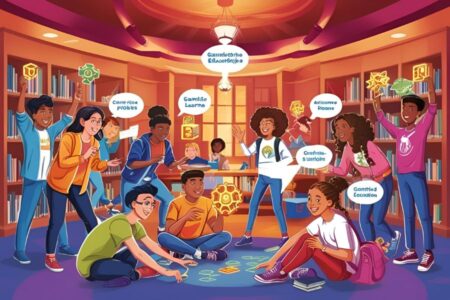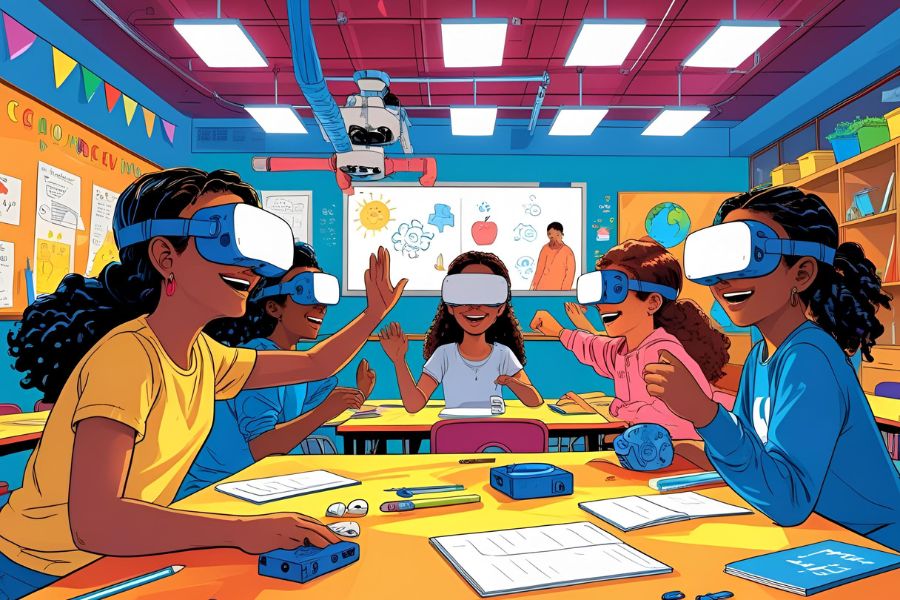
Gimkit allows students to play quizzes that are created like games. It has changed the methods of students’ learning. Could we try to improve it further? See yourself as a character in the game. Because of Virtual Reality (VR) and Augmented Reality (AR), this is now possible.
VR lets you feel as though you’re actually in the game and encounter new places. AR allows you to view and work with things in your environment using your phone or tablet. VR and AR in Gimkit could add an extra layer of enjoyment to learning. Students and teachers would have new ways to learn, play, and work together.
Table of Contents
Exploring VR and AR in Gimkit
To understand how VR and AR might change Gim kit. We need to first find out what these tools are and how they can be used in education.
Virtual Reality (VR)
With VR, an engaged environment is created. Putting on a VR headset lets you step into another world and take a break from reality for a while. In this environment, you can explore, move, and engage with 3D objects. For Gim kit, imagine being inside a big game board, where you are part of the game. VR can make learning feel real and fun. It can make learning more exciting by letting you explore and interact in a new way.
Augmented Reality (AR)
AR allows you to stay in the real world and see digital things added to what you see. Instead of creating a completely new world, AR enhances what you see with digital elements. It can show pictures, information, or interactive elements on your screen. If you’ve used a filter on your phone that adds fun glasses or ears to your face, you’ve seen AR. In Gim kit, AR could make your classroom more fun by adding questions or Gimkit learning game modes to the things around you. You could see and answer challenges on your desk or walls using your phone or tablet.
Also Read: Gimkit + Canva: Create Engaging Game Assets for StudentsGimkit in Virtual Reality: Stepping Inside the Game
Think about being able to put on a VR headset and feel like you are right in the Gimkit game. You will actually experience the art in front of you. You could be walking through a battlefield or swimming in a coral reef, answering questions and solving problems. VR can make Gimkit games feel real and fun in a way that a regular screen can’t. You will actively participate in the experience, not just observe it.
Immersive Learning Environments
What if the next time you played Gimkit, the game was in a 3D world? You could explore a coral reef while answering science questions or walk through an old city while learning about history. VR can bring new ways to learn in Gim kit. These fun, interactive environments would help students enjoy learning more. They would be able to experience the lessons in a real way, not just read about them.
Interactive 3D Objects for Questions and Answers
Questions can be displayed as 3D objects in Gim kit VR that students can explore. Instead of just clicking on multiple-choice answers, students might have to build something. Like putting parts of a cell together to answer a biology question. This way of learning is great for subjects like science. It helps students understand how things work by seeing and touching them.
Collaborative VR Learning
Teaching and learning in VR is also a great experience. Students can use VR to enter a room where they all have avatars and can collaborate on different issues. For example, they could be in a virtual escape room, solving puzzles using their knowledge from Gimkit. This type of learning helps students work together and share ideas while learning.
Gimkit in Augmented Reality: Bringing the Game into the Classroom
VR creates a new environment for us to explore. But AR enhances the world we are already living in. With AR Gimkit can become an interactive experience in the classroom. Regular objects can turn into fun learning tools.
AR Scavenger Hunts
AR can be used in Gimkit by setting up scavenger hunts. Students can use tablets to look for virtual clues around the classroom or school. When they find a clue, a Gimkit question or challenge will show up on their screen. This makes learning more fun and gets students moving and exploring.
Interactive AR Overlays
Using AR can help reading from textbooks or doing worksheets feel more enjoyable. Students can point their devices at a textbook page. And educational questions or cool facts can appear on the screen. These facts can be clicked on for more details, to answer questions, or even play small games related to the lesson.
AR Integration with Physical Activities
Exercise programs can also use AR. Gimkit games can be started by scanning a worksheet or poster in the classroom. This makes learning more exciting and mixes old-school learning with cool AR technology.
Why VR and AR Could Revolutionize Gimkit for Students
VR and AR are not only being included in Gimkit Dashboard for their novel features. These technologies could change the way students engage with and learn from educational material.
Increased Engagement
Learning is more fun when it is combined with VR and AR. Learning is actively shared by students, not only by the teacher. Students can solve challenges in a virtual world or search for AR clues around the classroom. These enjoyable tools turn learning into a game.
Deeper Learning
It has been found that students learn more effectively. VR and AR help students to see and experience difficult ideas in a hands-on way. For example, walking through the digestive system in VR or looking at the layers of the Earth in AR can help students understand these ideas better.
Collaboration and Communication
VR allows students to team up and collaborate. Students in a shared virtual space can solve problems, share their thoughts and learn together. This helps them build important skills like communication and teamwork that they can use in school and later in life.
Personalized Learning
How a student learns can affect how VR and AR are used. Students in VR can control their own experience and move at their own speed. With AR, students can get instant feedback and help with tasks that match their skills.
Also Read: Gimkit Gamified Learning Strategies That Improve Engagement and Knowledge RetentionChallenges and Factors to Consider for Adding VR and AR to Gimkit
Although the possibilities of VR and AR in Gimkit exciting features. There are some challenges to address before these technologies can be fully used in the classroom.
Cost and Accessibility
VR and AR are expensive which is one of their issues. The cost of VR headsets is high, so many schools are unable to give them to their students. Also, students who don’t have AR-enabled phones or tablets may miss out on these experiences.
Infrastructure and Technical Requirements
Both VR and AR depend on strong internet as well as powerful devices. Schools may have to spend money on better equipment to make sure these tools work right. Teachers will also need training to use these new tools, which might take some time to learn.
Potential for Motion Sickness (VR)
Some students may feel slightly off or uneasy. After trying VR headsets. It can cause the person to feel awkward. Some students might find it hard to use because of these issues. This problem needs to be fixed before VR can be used in schools. It is important to make sure that everyone can enjoy and learn with VR without feeling bad. Addressing this issue will help VR become more useful in education.
Pedagogical Soundness
VR and AR need to enable students to learn more and not only act as entertainment. The tools should actually benefit students and teachers. VR and AR should make learning more engaging and enjoyable. They need to support students in staying focused on the lesson rather than causing distractions. The goal is for these technologies to improve learning and help students understand the material.
Conclusion:
When VR and AR are used in Gimkit, learning becomes more interesting. Students can use VR to enter virtual worlds or use AR to see the real world in a new way. These technologies have the potential to transform learning and make it more enjoyable.
Even so, some issues continue. For example, how simple it is for students to use and the technology involved. With thoughtful planning, Gimkit Join can improve and become even more effective in the future. VR and AR could help make learning easier and more interesting for students.